From Data to Better Health Outcomes: The Case for Transcendental Intelligence in Healthcare
 Hindustan Bytes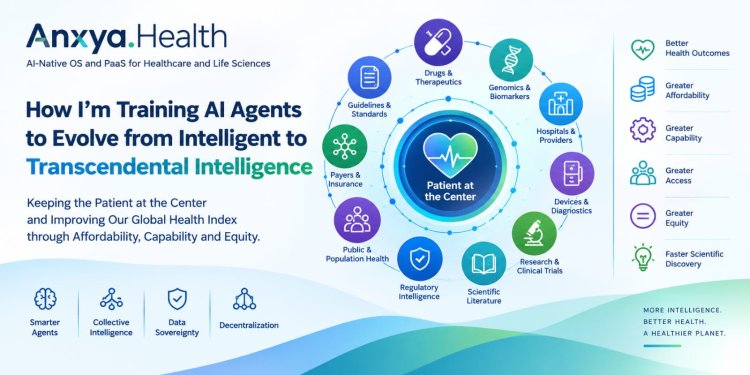
Healthcare does not need more information alone.
It needs intelligence that can transform fragmented data into verified knowledge, meaningful insight, responsible action and measurable improvements in human health.
That is the vision behind Anxya.Health: an AI-native operating system and platform for healthcare and life sciences designed to support a continuously improving, evidence-grounded and governed collective of specialized agents.
At the center of this vision is a simple principle:
The patient must remain the center of every decision.
Beyond Chatbots and Automation
The next generation of healthcare AI will not be defined by chat interfaces or isolated automation.
It will be defined by systems that can:
- Understand complex clinical and scientific contexts
- Connect knowledge across fragmented sources
- Evaluate evidence and uncertainty
- Coordinate specialized agents and workflows
- Detect contradictions and emerging signals
- Preserve data sovereignty
- Support human decision-making
- Measure real-world outcomes
This is not intelligence for its own sake.
It is intelligence designed to serve life.
From Data to Outcomes
Healthcare organizations generate enormous volumes of data across clinical systems, research databases, diagnostics, devices, trials, regulatory sources and patient interactions.
Yet data alone does not improve health.
The transformation must be:
Data → Information → Knowledge → Evidence → Understanding → Insight → Action → Measurable Outcome
Each step requires governance, context and verification.
A reliable healthcare intelligence system must preserve the source, date, provenance, confidence and applicability of every material claim. It must distinguish between what is known, supported, probable, uncertain, contradicted and unknown.
Confidence must never be mistaken for truth.
Collective Intelligence for Healthcare and Life Sciences
No single model, institution or agent can understand the full complexity of healthcare.
A more powerful approach is a governed collective of specialized intelligence, including:
- Clinical agents
- Disease and drug agents
- Diagnostics and medical-device agents
- Research and literature agents
- Trial and regulatory agents
- Genomics and biomarker agents
- Patient and hospital agents
- Safety and verification agents
- Public-health and payer agents
These agents can collaborate through structured workflows while maintaining clear boundaries, permissions and accountability.
The goal is not to create artificial consensus.
The goal is to enable independent perspectives to generate, challenge, verify and reconcile knowledge—while preserving disagreement when uncertainty cannot be resolved.
Scientific Discovery Requires Humility
AI can help identify:
- New research hypotheses
- Drug repurposing opportunities
- Biomarker relationships
- Disease mechanisms
- Clinical-trial opportunities
- Research gaps
- Diagnostic possibilities
- Novel therapeutic pathways
But a hypothesis is not a discovery until it has been appropriately validated.
A correlation is not automatically causal evidence. A statistically interesting relationship is not necessarily clinically meaningful. A model output is not a substitute for scientific review.
Transcendental intelligence must expand discovery while remaining humble before uncertainty.
Data Sovereignty by Design
Healthcare intelligence cannot be built by treating data as an unlimited resource.
Patient, institutional and jurisdictional authority must remain central.
Responsible systems should respect:
- Consent
- Purpose limitation
- Access controls
- Privacy
- Security
- Data minimization
- Retention requirements
- Revocation
- Provenance
- Jurisdictional obligations
Where appropriate, intelligence should move to the data rather than unnecessarily moving sensitive data to the intelligence.
Federated learning, privacy-preserving computation, local inference and distributed knowledge systems can enable collaboration without requiring global centralization.
The objective is:
Global collaboration without requiring global centralization.
Human and AI Intelligence
The purpose of healthcare AI is not to eliminate human responsibility.
It is to augment human capability.
Clinicians, researchers, patients, regulators and healthcare leaders must remain able to:
- Understand
- Question
- Correct
- Override
- Audit
- Approve
- Reject
- Investigate
High-risk, ambiguous and consequential decisions require appropriate human oversight.
The best AI systems will not make humans less accountable. They will help humans become more informed, more capable and more effective.
Measuring What Matters
Healthcare AI should not optimize for more tokens, more data, more agents or more automation.
It should optimize for outcomes such as:
- Patient safety
- Health outcomes
- Access to care
- Equity
- Affordability
- Quality
- Timeliness
- Scientific progress
- Population health
No system should claim improvement without evidence.
A truly intelligent healthcare platform must continuously ask:
- What changed?
- What evidence supports the change?
- Who benefited?
- Who may have been excluded?
- What risks emerged?
- What remains unknown?
- Did the workflow improve the outcome?
The Future of Healthcare Intelligence
The future will not belong to systems that simply generate answers faster.
It will belong to systems that can responsibly discover what humanity needs to know, verify what is true, connect what is fragmented, reveal what is hidden and help transform knowledge into better health outcomes.
That requires intelligence that is:
- Evidence-grounded
- Patient-centered
- Transparent
- Collaborative
- Secure
- Sovereign
- Decentralized where appropriate
- Continuously improving
- Accountable to human values
Anxya.Health is built around this direction: evolving healthcare intelligence without losing sight of the people it exists to serve.
Become more intelligent without becoming less human-centered.
Website : https://www.Anxya.Health