Beyond the Visible: Author Nithin Radha Krishnan Explores the Laws of Existence, Truth, and Awareness in Echoes of the First Cause
 BMRD
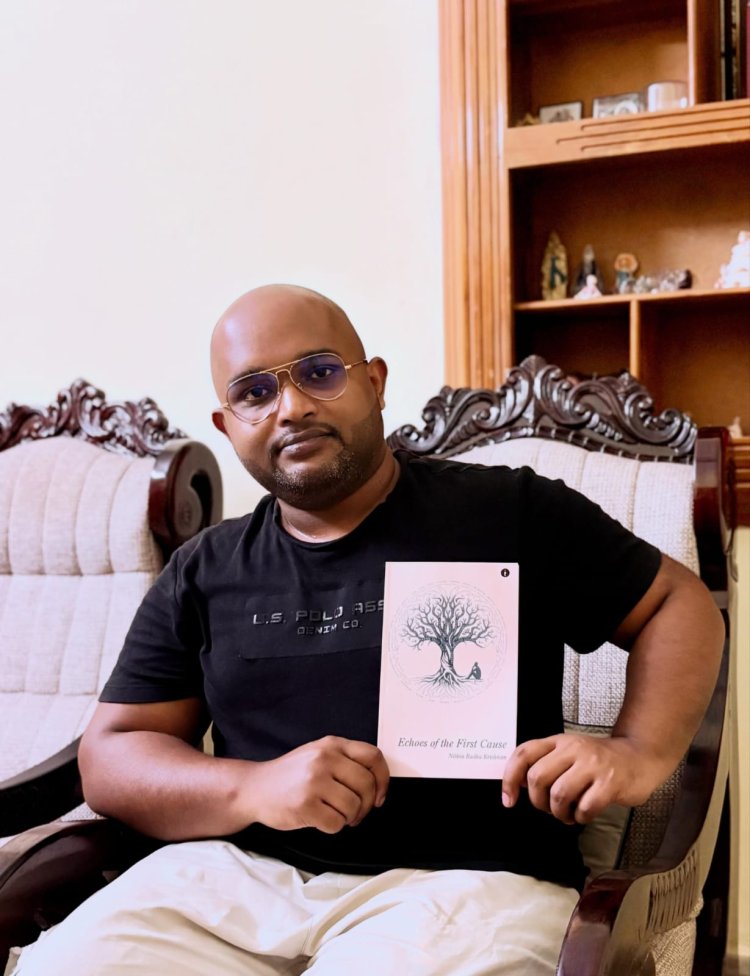
What lies beneath the experiences that shape human life? How do fear, loss, desire, time, and choice influence the way people understand themselves and the world around them? In Echoes of the First Cause, Author Nithin Radha Krishnan explores these questions through poetry, inviting readers to look beyond individual experiences and reflect on the deeper principles that may connect them. Rather than offering definitive explanations, the book creates space for contemplation, allowing complex ideas about existence and human experience to unfold through concise language and evocative imagery.
The collection develops around the idea of the “Laws of Becoming,” moving through themes such as fear, anger, desire, loss, choice, cause and effect, balance, impermanence, unity, silence, truth, and awareness. Instead of following the structure of a conventional argument, the book gradually unfolds through observations and questions, guiding readers from familiar emotional experiences towards broader reflections on meaning and what may remain beneath the surface of existence. Images of light and darkness, storms and stillness, seeds and trees, rivers and changing seasons help translate abstract ideas into experiences readers can visualise and interpret.
Drawing on observations shaped by encounters with different communities, cultures, and circumstances across India, Nithin Radha Krishnan examines the emotions, contradictions, struggles, and choices that connect people despite their differences. His poetry does not attempt to impose a single interpretation or provide a final answer to every question. Instead, it encourages readers to engage with the ideas at their own pace, recognising that the meaning of a poem can change with personal experiences and stages of life. Through Echoes of the First Cause, the author presents poetry as a space for reflection, where silence can be as meaningful as words and the process of questioning can be as valuable as finding answers.
1. What draws you to the medium of poetry, and how do you believe it offers a distinctive way to communicate emotions and ideas?
Poetry allows me to express something that may be difficult to communicate through straightforward explanation. An idea can exist intellectually, but poetry gives it atmosphere, emotion, rhythm, and space. I am particularly drawn to the way a few carefully chosen words can suggest something much larger than what they explicitly say.
For Echoes of the First Cause, poetry also felt appropriate because the subjects are not always things that can be explained conclusively. Fear, loss, silence, truth, awareness, and becoming are experiences we encounter before we fully understand them. Poetry allows those subjects to remain open, so that the reader can recognise something of their own experience within them.
2. Can you share the inspiration behind the theme of your poems, and how it influenced their tone and structure?
The book began with a curiosity about what lies beneath the experiences that shape us. Rather than treating individual experiences as isolated events, I became interested in whether there are deeper principles connecting them. That eventually developed into the idea of the “Laws of Becoming.”
The book moves through different aspects of existence—fear, anger, desire, loss, choice, time, balance, cause and effect, impermanence, unity, silence, truth, awareness, and becoming—before arriving at broader questions about meaning and what remains beneath everything we experience. So, the book developed less as a conventional argument and more as a gradual unfolding of questions and recognitions.
3. Poetry often invites readers to interpret and connect on a personal level. How do you navigate the balance between conveying your intended meaning and leaving room for individual interpretation?
I did not want the book to prescribe a single interpretation. Many of the subjects explored in it—loss, fear, purpose, truth, or silence—can be experienced very differently by different people.
My intention was therefore to offer an observation rather than close the question. A poem may begin from a particular insight, but once it reaches the reader, it becomes part of that reader’s own experience. Something that feels abstract at one point in life may acquire an entirely different meaning after a personal loss, a change, or a moment of understanding. I see that openness as an important part of the book rather than something that needs to be resolved.
4. Can you describe your approach to crafting the musicality of your language, and how it contributes to the overall experience for readers?
These elements are important because the poems are meant to be experienced as much as understood. I tend to favour concise language and recurring images that carry meaning without requiring extensive explanation.
The manuscript repeatedly works with images such as light and darkness, movement and stillness, seasons, storms, seeds, trees, rivers, and silence. These images create connections between the individual poems while also allowing abstract ideas to become more tangible. Repetition and pauses are also intentional. Sometimes what is left unsaid can carry as much weight as the words themselves.
5. Many poets draw inspiration from their own experiences. How does your personal journey and background influence the themes and imagery in your poetry?
My experiences have shaped the questions I ask and the way I observe people and life, rather than serving as a direct autobiography within the book.
Having lived in different parts of India and encountered people from varied communities, cultures, and circumstances exposed me to many different ways of understanding life. Over time, I became increasingly interested in the things that remain recognisable beneath those differences—the emotions, contradictions, choices, struggles, and searches that are common to people.
The book draws from that observation, but transforms personal experience into broader reflections rather than recounting particular events from my life.
6. In your work, how do you use poetry as a means of commentary or reflection on the world around you?
The book looks at the human condition from beneath its visible circumstances. Instead of focusing primarily on social events or contemporary issues, it examines the forces that repeatedly shape human lives. Fear can influence choice. Desire can create attachment. Loss can alter perception. Actions have consequences. Opposites such as joy and sorrow exist alongside one another. Silence can reveal something that constant activity obscures.
Chapters such as Cause and Effect, Balance, Impermanence, Silence, Truth, and Awareness explore these patterns from different directions. The intention is not to provide social commentary in the conventional sense, but to step back from individual situations and consider the underlying structures through which people experience life.
7. Readers may be curious about your writing rituals. Can you share any specific routines or practices you find helpful in cultivating your creativity and honing your craft as a poet?
I do not follow a fixed writing ritual. The process usually begins with something that catches my attention—a question, an observation, an emotion, or an experience that continues to stay in the mind. I tend to let such ideas develop rather than immediately trying to give them a final form. Quietness and distance are important to that process because they allow an idea to move beyond its immediate emotional reaction and reveal what may be underneath it.
When I begin writing, I am not necessarily looking for a conclusion. Often, the writing itself becomes a way of discovering what the question is really pointing towards. That approach is reflected in the structure of Echoes of the First Cause, where the reader is invited to move through the ideas rather than simply being given a set of answers.
For those drawn to contemplative poetry, philosophical questions, and reflections on the human condition, Echoes of the First Cause offers an invitation to pause, observe, and explore what lies beneath the visible.
Order your copy of Echoes of the First Cause by Author Nithin Radha Krishnan on Amazon today and embark on a poetic exploration of existence, truth, and the journey of becoming.