Pitru Paksha 2026: Acharya Hemanshu Explains the Vedic Significance of Shraddha, Ancestors and Pitru Dosha
 maniv
maniv
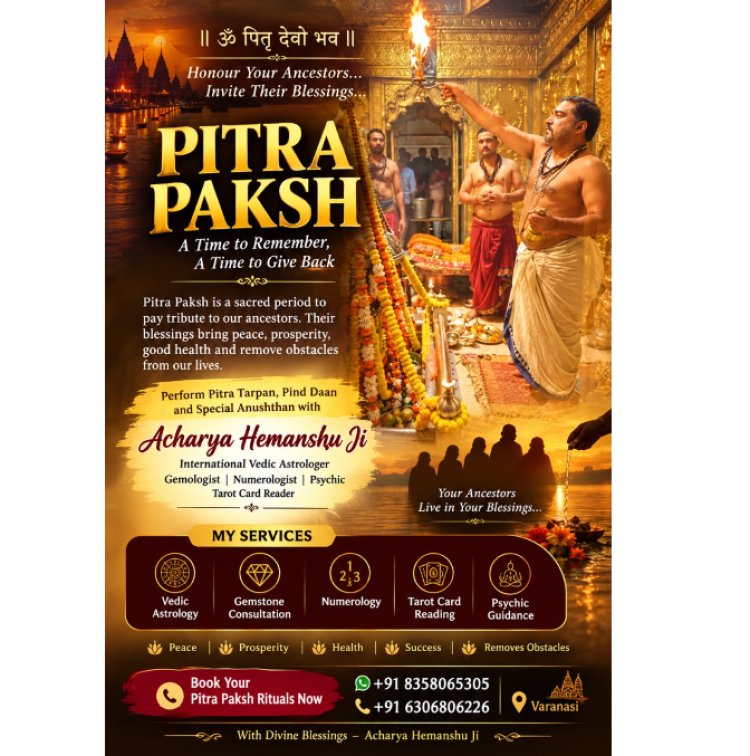
Understanding the Spiritual and Astrological Importance of Pitru Paksha
Varanasi, India – As Pitru Paksha approaches in 2026, families across India and Hindu communities around the world are preparing to observe one of the most significant periods dedicated to remembering and honouring ancestors. According to traditional Hindu calendars, the main Pitru Paksha period in 2026 begins on 27 September and concludes with Sarva Pitru Amavasya on 10 October. The exact Shraddha date for an individual ancestor is traditionally decided by the lunar tithi and the local Panchang.
Acharya Hemanshu, an international Vedic astrologer, gemologist, numerologist and psychic, explains that Pitru Paksha is fundamentally a period of remembrance, gratitude, spiritual reflection and traditional ancestral observance.
What Is Pitru Paksha?
Pitru Paksha, also known as Shraddha Paksha or Mahalaya Paksha, is traditionally observed for approximately fifteen to sixteen lunar days, depending on how the calendar is counted. During this period, families perform ancestral rites such as Shraddha, Tarpan and Pind Daan, according to their family traditions and regional customs.
The Sanskrit concept of Shraddha is associated with faith, reverence and sincere devotion. The observance therefore represents more than a ritual. It gives families an opportunity to remember previous generations and acknowledge the role ancestors have played in shaping the family lineage.
Why Is Pitru Paksha Important?
According to Vedic tradition, ancestral remembrance is an important aspect of spiritual and family life. Acharya Hemanshu says that Pitru Paksha can be understood through three principles:
- Remembrance: remembering those who came before us.
- Gratitude: acknowledging the sacrifices, values and contributions of previous generations.
- Responsibility: carrying positive family values forward to future generations.
This makes Pitru Paksha relevant even in today's modern world, where families may be geographically separated from one another.
Pitru Paksha and Tarpan
Tarpan is one of the traditional practices associated with ancestral observance. Water and other prescribed offerings may be made while remembering one's ancestors. The specific procedure can differ according to family tradition, region and religious practice. For this reason, people undertaking formal Shraddha rituals are traditionally advised to follow their family customs or seek guidance from a knowledgeable priest or Acharya.
The Significance of Pind Daan
Pind Daan is another important ancestral ritual in Hindu tradition. Gaya in Bihar is particularly associated with Pind Daan and ancestral rites, and thousands of devotees traditionally visit the city to perform rituals for departed family members. However, ancestral observances are not limited to one geographical location. Different communities follow different customs depending on their lineage, region and family tradition.
Pitru Dosha and Vedic Astrology
Pitru Paksha also receives particular attention among followers of Vedic astrology because of the traditional concept of Pitru Dosha. In Vedic astrology, an astrologer may examine the Sun, the ninth house, the ninth lord and other planetary combinations while assessing ancestral themes in a horoscope.
However, Acharya Hemanshu emphasises that a single planetary combination should not automatically be labelled as Pitru Dosha. In his words:
“A horoscope should always be studied as a complete system. Before recommending any spiritual remedy, the relevant planetary combinations, houses, Dashas and the individual's circumstances should be examined carefully.”
The interpretation of ancestral indications can therefore vary from one horoscope to another.
Should Everyone Perform the Same Remedy?
Not necessarily. Traditional Vedic practices can differ depending on the individual's family tradition, ancestral tithi, location and circumstances. Common forms of observance may include:
- Shraddha according to the appropriate tithi
- Tarpan
- Pind Daan
- Charity and food donation
- Offering food according to family tradition
- Prayer and remembrance of ancestors
- Feeding animals as part of charitable or devotional practice
The appropriate practice should be determined by the individual's own tradition rather than by a one-size-fits-all approach.
Sarva Pitru Amavasya: The Final Day
The final day of Pitru Paksha, commonly known as Sarva Pitru Amavasya, has particular importance. It is traditionally observed as an opportunity to remember all ancestors, including in circumstances where the exact ancestral tithi may not be known. In 2026, Sarva Pitru Amavasya falls on 10 October, subject to local Panchang calculations.
Pitru Paksha in the Modern World
For many people, Pitru Paksha is also an opportunity to reconnect with family history. Remembering grandparents, great-grandparents and earlier generations can help younger family members understand their roots and preserve cultural traditions.
According to Acharya Hemanshu, the deeper message of Pitru Paksha is not fear but gratitude and awareness. Rather than viewing ancestral traditions only through the lens of problems or obstacles, individuals can approach the period as a time for prayer, charity, remembrance and reflection.
Acharya Hemanshu on Ancestral Awareness
Acharya Hemanshu is associated with Vedic astrology, Kundali analysis, numerology, gemstone guidance and spiritual practices. He explains that anyone concerned about ancestral indications in their horoscope should first understand the complete astrological picture rather than assuming that every family difficulty is connected to Pitru Dosha.
A detailed Kundali analysis can examine the relevant houses, planets, Dashas and traditional combinations before any remedial practice is considered.
The Message of Pitru Paksha
Pitru Paksha ultimately reminds families of a simple principle:
“Honour your ancestors, respect your roots and carry the wisdom of previous generations into the future.”
For millions of Hindu families, these days remain an important annual period of remembrance, prayer, charity and spiritual reflection.
About Acharya Hemanshu
Acharya Hemanshu is an international Vedic astrologer, gemologist, numerologist and psychic, offering guidance related to Vedic astrology, Kundali analysis, numerology, gemstone consultation and spiritual traditions.